Machine-Learning Force Fields
A model trained on quantum calculations predicts forces for reactive and aqueous simulations at larger sizes and longer times than direct electronic calculations.
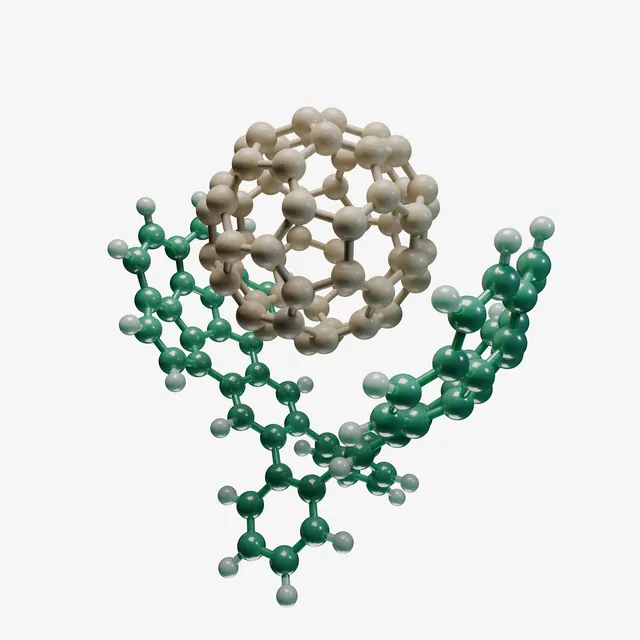
Buckycatcher molecule
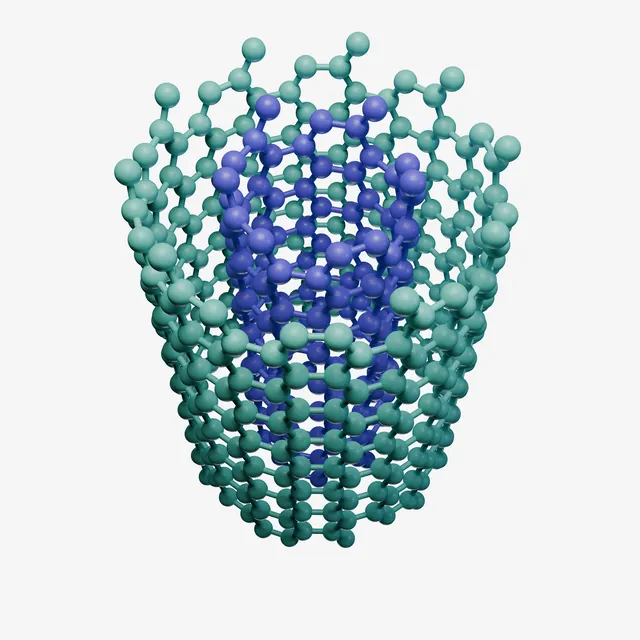
Double-walled carbon nanotube
Learning Energies and Forces
A machine-learning force field (MLFF) is a model trained on quantum calculations to predict atomic energies and forces. Each training example contains one arrangement of atoms and the quantum result for that arrangement. The model learns a continuous relationship between structure and energy. Once trained, it predicts energy and forces at every step.
A Domain Defined by Training Data
That speed supports longer trajectories and larger systems with atom-level detail. It can follow water around ions and some reactions in which bonds change, extending phenomena seen briefly in direct quantum dynamics. Separate quantum calculations and experimental observables define the chemical environments represented by the training data and the model's working range.
Questions We Study
We use MLFF trajectories to ask why different salts slow or speed water, how a water molecule joins the shell around Al³⁺, and how acetic acid oxidizes in supercritical water, water under high temperature and pressure. Full trajectories yield averages, rates, and reaction pathways. In salt water, correlated motion between water molecules distinguishes the salt response. The density of training structures near a high-energy reaction step controls the accuracy of the predicted barrier.
A Loop Between Scales
MLFF results can guide simpler force fields by supplying target structures, motion, and rates. Configurations with high prediction uncertainty return to DFT for new reference values. DFT sets the reference, and the MLFF maps training coverage and selects the next calculations.
Related Publications
Yu et al., Science Advances (2024), Water diffusion anomalies via MLFF
Ryu et al., J. Mol. Liquids (2024), Dielectric relaxation of water
Ryu et al., J. Chem. Inf. Model. (2025), Acetic acid in supercritical water