Mesoscale Modeling
Coarse-graining groups several atoms into simplified units to reach larger systems and longer collective motion.
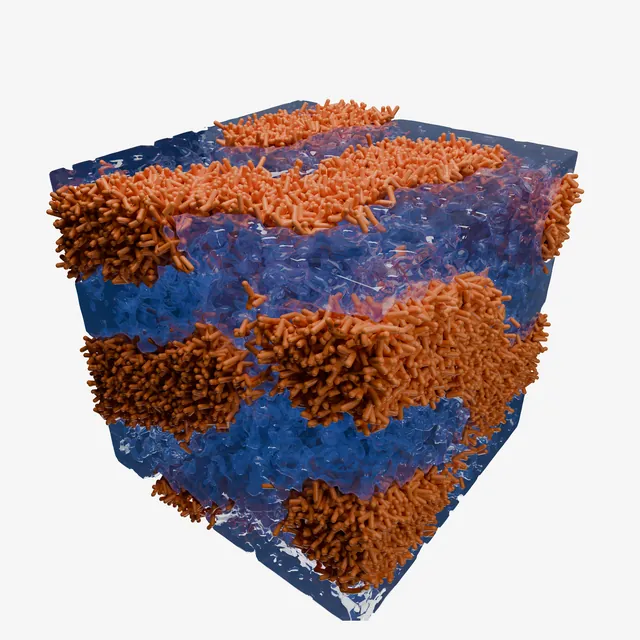
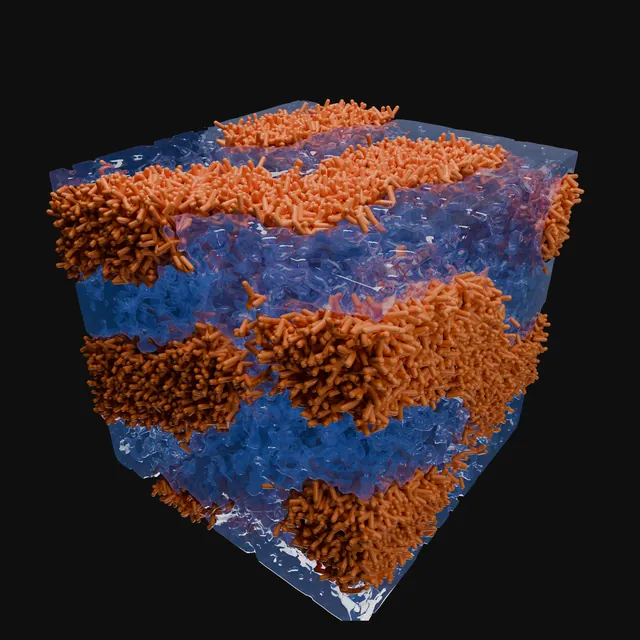
Double-gyroid polymer structure
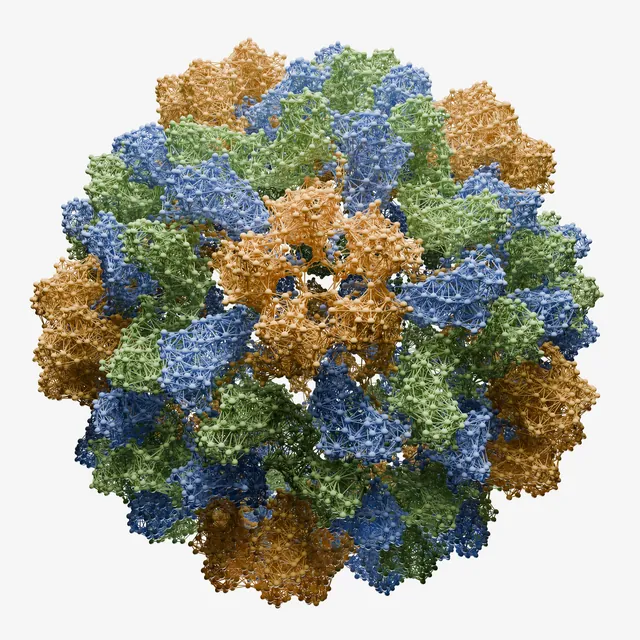
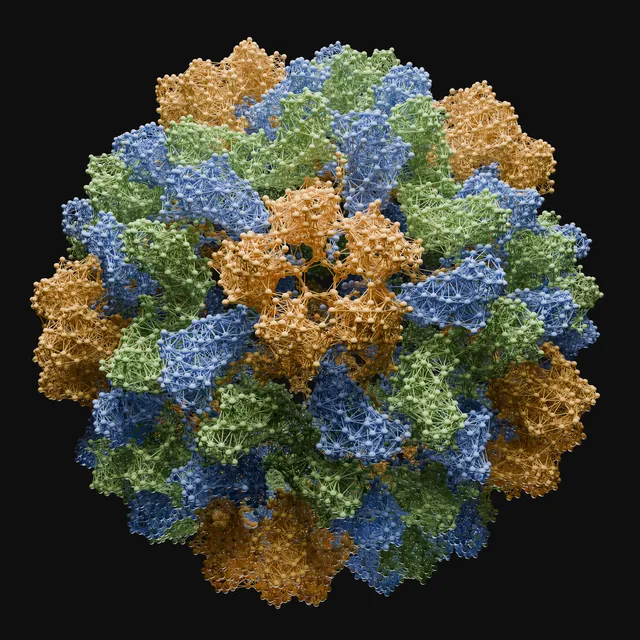
Icosahedral viral capsid
Collective Behavior from Simpler Units
Coarse-graining groups several atoms into one interaction site, often called a bead. By reducing particle count and smoothing fast motion, a coarse-grained simulation can follow larger systems and slower collective changes. The model preserves chosen features such as a polymer chain's shape and connectivity. The mapping sets the computational reach, resolution, and atomic details that are averaged out.
Questions at This Scale
Many material properties emerge from assemblies of molecules. Polymer networks become elastic, block copolymers form repeating structures, and coated nanoparticles organize into crystals. These patterns require the wider size and time scales available to coarse-grained models. Their predictions compare directly with repeat distances from scattering and structures seen in microscopy.
How We Use It
For polymer-grafted nanoparticles, we connect the shape of the soft polymer coating to the ordered particle arrangement that forms. A single bottlebrush polymer, a backbone crowded with side chains, can give a particle direction and select square, hexagonal, or chain-like order. For hydrogels, water-rich polymer networks, we relate strand shape and contacts to elasticity. We also study how polymer brushes, layers of chains fixed to a surface, change the attraction between embedded objects.
How the Model Is Checked
We fit effective bead interactions to atomistic trajectories or experimental measurements, then test the target structures and responses. The calibration targets define the model's working range. Tests of additional observables expand that range.
Related Publications
Yu et al., Advanced Science (2024), Two-regime conformation of grafted polymers
Kim et al., Langmuir (2025), Bottlebrush-driven nanoparticle assembly
Rho et al., ACS Appl. Mater. Interfaces (2025), Hydrogel elasticity
Yu et al., Chemical Physics Reviews (2025), Review: self-assembly of architected macromolecules