Density Functional Theory (DFT)
DFT calculates how electrons are distributed, revealing energy changes, atomic forces, and reactive regions for selected molecular structures.


Woven framework COF-505

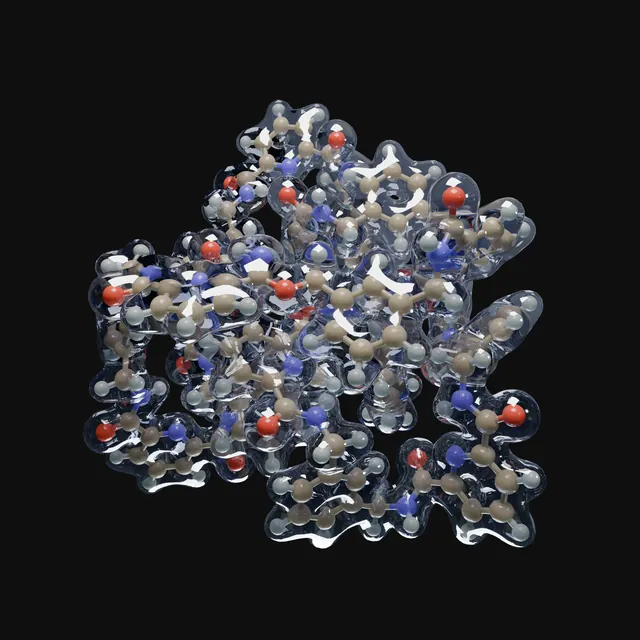
Trefoil molecular knot
Reading Chemical Change from Electron Density
Density functional theory (DFT) is a quantum-mechanical calculation of how electrons are distributed around atomic nuclei. Because bonds form from shared electrons, changes in that distribution help locate reactive sites, compare possible structures, and estimate energy changes when molecules interact or rearrange. DFT returns an energy and the force on each atom for one chosen arrangement. These quantities can be compared with measurements or used as reference data for other models.
Where DFT Fits
The electronic distribution must be solved again whenever the atoms move, so the computational cost rises quickly. This cost focuses DFT on small systems, carefully selected snapshots, and chemical changes governed directly by electron motion. Experiments and more demanding reference calculations benchmark difficult cases.
How We Use It
In our work, DFT supplies examples for a machine-learning force field (MLFF), a model trained to predict atomic energies and forces. The examples include ordinary liquid structures and less common arrangements near ion exchange or bond rearrangement. Configurations with high MLFF uncertainty return to DFT and expand the training data. This loop anchors the faster model to quantum calculations and defines its trained chemistry.
What Moves to the Next Scale
Each reference record pairs atomic species and coordinates with energy and forces. The record also identifies how the calculation was produced, so later comparisons remain traceable. An MLFF learns the relationship across many such records and extends it to larger systems and longer trajectories.