All-Atom Molecular Dynamics
All-atom molecular dynamics follows every atom with fixed interaction rules, reaching the trajectories needed to study structure, transport, and relaxation.
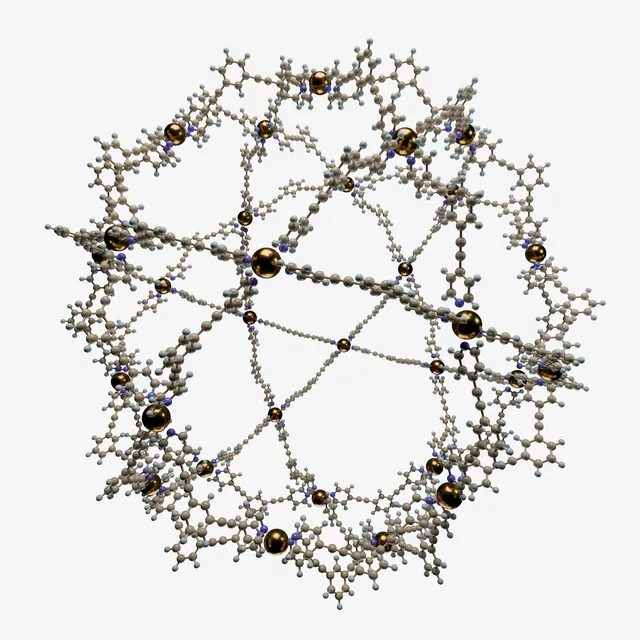
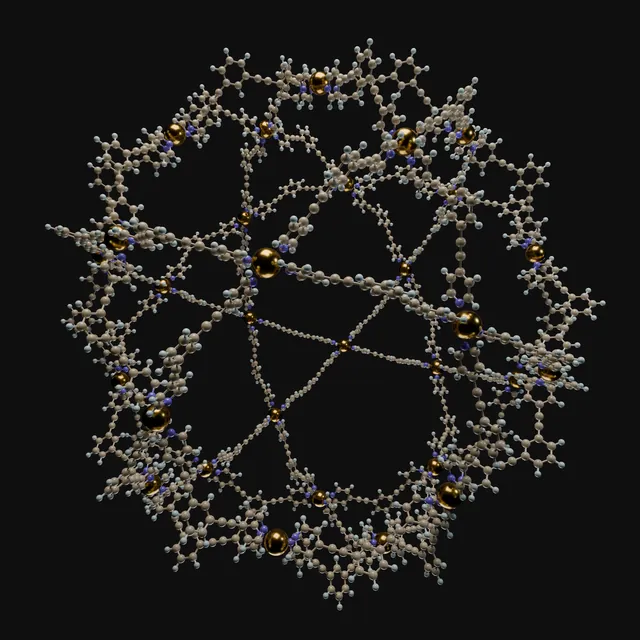
Pd₃₀L₆₀ Goldberg cage
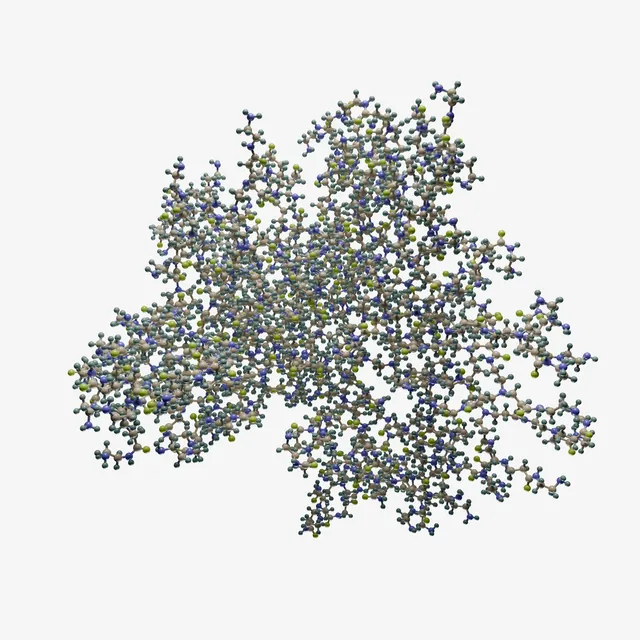
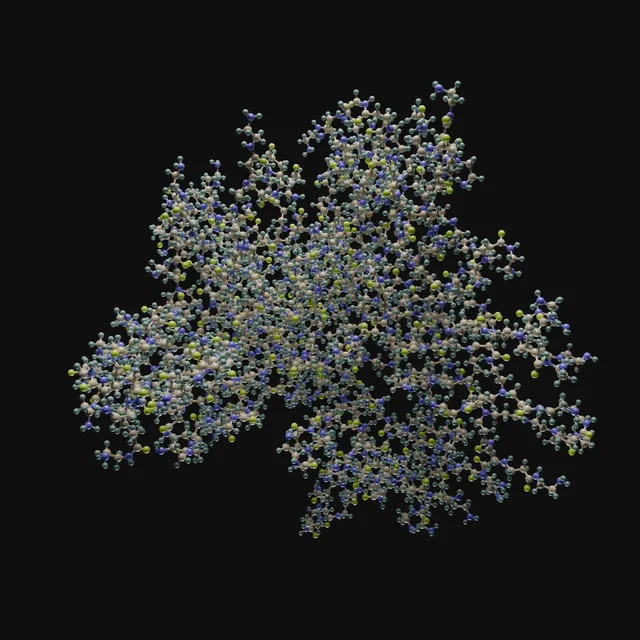
Branched PAMAM molecule
Following Molecular Motion
All-atom molecular dynamics (MD) follows every atom over time. A classical force field supplies fixed mathematical rules for interactions between bonded atoms and nearby nonbonded atoms. This representation preserves chemical identity and local molecular geometry. Each inexpensive step retains solvent and ions, allowing long trajectories to accumulate.
Properties from a Full Trajectory
Measurements across many frames yield diffusion rates, structural relaxation, averages, and variation. All-atom MD is suited to liquid structure, molecular transport, polymer ordering, and local mechanical response. Its fixed bonding pattern covers structure and transport; bond-changing reactions use reactive force fields or electronic methods.
How We Use It
In model glasses, we pull a small probe and read the surrounding material's response from the resisting force, an approach called active microrheology. The force separates motion inside a temporary cage of neighboring atoms from slower structural rearrangement. In block copolymers, polymers made from linked segments with different chemistry, simulations designed to cross rarely visited structures reveal an intermediate network of misaligned cylinders on the way to ordered packing. Across both systems, complete trajectories resolve the sequence of structural change.
A Reference for Simpler Models
All-atom results also provide targets for coarse-grained models, which group several atoms into one unit. Structural distributions, relaxation behavior, and their uncertainty define what the simpler model should reproduce and set its working range.
Related Publications
Yu et al., Science Advances (2020), Active microrheology of metallic glass
Madanchi et al., Soft Matter (2021), Friction dynamics in glass
Seo et al., Soft Matter (2020), Cylindrical microphase separation
Kim et al., J. Phys. Chem. Lett. (2024), Al³⁺ dissolution